 Photos - Bob Seary
'If poisonous minerals, and if that tree,
Whose fruit threw death on else immortal us,
If lecherous goats, if serpents envious
Cannot be damn'd, alas, why should I be?'
If you know your poetry, really know your poetry, you'll know these lines open a hornet's nest, but also metaphysical 17th-century poet John Donne's ninth. No, not symphony, but holy sonnet, batman. But I can hardly expect you to know something I don't, or didn't, know myself.
Vivian Bearing would've known it though. Professor Vivian Bearing, to you. Dr Bearing. PhD (English Lit.). Rigorous, uncompromising John Donne scholar. 50. Unmarried. Barren. No family or friends. Her constant companion, now, is cancer. Advanced metastatic ovarian cancer. Stage four. There's no stage five.
“Nothing but a breath, a comma, separates life from life everlasting. It's very simple really.”
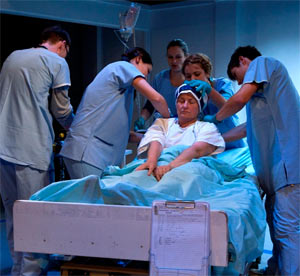
Despite her characteristic, defining determination to rail against her affliction and despite having embarked on a radical, experimental regimen of treatment, part of a research program, she's beginning to shrink. To her doctors she's data waiting to be gathered. The good doctor embarks on a torturous journey, from intellectual detachment and stern solemnity, peppered with withering wit, into the softer realm of kindness and compassion. She witnesses the tragedy of the depletion of both her mind and body and is forced to wrestle with the challenge of holding onto what is, in the end, truly essential and valuable. John Donne has been her obsession, her reason for being, but even he is relinquished. American playwright Margaret Edson's first play won a Pulitzer & Best New Play from the New York Drama Critics' Circle, putting New Theatre director, Jane Eakin, her crew and cast well out in front, from the get-go. The original production premiered in California, which has many more palm trees than King Street, Newtown but, one suspects, on the evidence, little has been lost in translation from locale to locale. That was 1995. Eakin has made ta sensible decision in adapting the vernacular and idiom according to the decade-and-a-half that has elapsed and transposition to Sydney, an ocean away from our Californicating cousins.
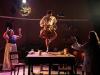
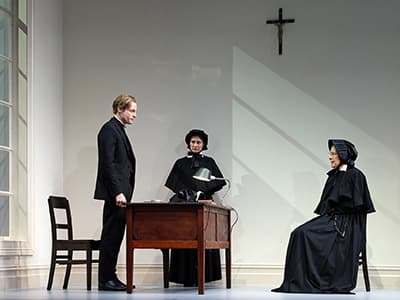
On entering the theatre, one is struck by set designer, James Croke's stark, sterile, sheer white hospital curtains, which are cleverly arranged, at pleasing angles, to create the possibility of different spaces and places. It is the epitome of elegant, intelligent design. Lighting designers, Siobhan Callanan and Deidre Math have worked in concert, opting for a hard, blinding fluorescence and the odd spot. Erica Heller-Wagner has ensured doctors are attired with typical oblivion to taste, style and fashion; academics and not-so-doting dads look suitably stuffy; patients confined to formless, depersonalising gowns.
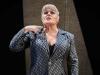
Karen Bayly's transition, or transformation, from hard-bitten mistress of her poetic universe to hapless, powerless cancer victim is a sudden one; a little too sudden. While, for the most part, she effects distress with heartrending authenticity, we don't necessarily see the trajectory of the meltdown that would make the difference between acting and becoming lost in the character's journey. It was opening night and it's a very demanding role, with reams of monologue and dialogue, so any criticism is liable to be somewhat churlish and uncharitable; nonetheless, my hankering to suspend disbelief was hampered by a sense she was so busy attending to ensuring the next line skipped down the neural pathway from memory to meet her lips, it compromised the performance, as such. That is, it was, at times, more like a reading, albeit sans script, than an actual play.
While Dr Bearing's character is, clearly, intended to be dry, it would have been judicious to allow or instruct Bayly to let a little more self-doubt seep through the cracks in her forbearance. Again, enhanced credibility would've been the result. And the pivotal, pathetic scene in which Bearing flashes back to being five, at her father's knee, was a profound opportunity lost, with the alteration in Bearing's, well, bearing, being almost undetectable.
Matt Butcher was the goods, as Harvey Kelekian (and in a cameo, as Mr Bearing, Vivian's father), for whom patient care and bedside manner are very much subservient to research. Another Matt, Matt Charleston, as hungry, young doctor, Jason Posner, ups the ante in showing barely concealed, transparent disdain for people, as against results. In communicating the cluelessness of their characters as regards their clinical and human deficiencies, both excel. And the interactions between Vivian and Jason, especially, are imbued with a sneaking affection; abiding, underlying respect; mutual recognition and empathy.
The supporting cast was uneven, with the least (Dr Bearing's students, lab technicians, researchers and other hospital staff) being, at worst, sufficient, notwithstanding some occasional tendencies to overdo it.
Margaret McManus showed depth, as Bearing's mentor, E. M. Ashford, another hard taskmistress, from whom Bearing took more than knowledge and insight into Donne: she mimics her demeanour, in reverent homage to uncompromising scholarship. McManus, on the one hand, is the impenetrably demanding teacher; on the other, the softhearted, surrogate mother.
Another affecting performance, and a luminous one, comes from Shondelle Pratt, as big-framed, bighearted nurse, Susie Monahan; the kind of nurse we've all known who, regardless of being underpaid, overworked and the all-too-easy temptation to succumb to the physical and emotional burdens of care, treat each patient as an individual; with warmth, compassion and sincerity. Or are so adept at faking it, it makes no difference. A box-of-chocolates nurse. Pratt makes Monahan embraceable.
W;t grapples with regret, relationships, the here-and-now, the hereafter, life, death, the unattainable, inescapable and ineffable; with choices & compulsions; the professional and personal. In meditating on these subjects, and more, especially through its central character and the focus of her career, it is comprehensively successful. But, dare I say it, even a Pulitzer doesn't guarantee outright perfection: while the rather cinematic notion of having other characters engaged in conversation 'under' the monologue looks good on paper, it's very hard to pull off, given the limitations of mixing sound on stage. And the final scene, in which the just deceased Bearing leaves her bed and disappears behind a veil of curtain, walking in to the veritable light, could be seen as something of a surrender to soft-option cliche, although there is toughness in the final note being sounded by the self-obsessed young doctor. Life goes on. Gone, but not forgotten? Remembered fondly, without judgment; basking, for eternity, in unconditional love? We should be so lucky.
'Of Thine only worthy blood,
And my tears, make a heavenly Lethean flood,
And drown in it my sin's black memory.
That Thou remember them, some claim as debt; I think it mercy if Thou wilt forget.
New Theatre presents
W;t
by Margaret Edson
Directed by Jane Eakin
Venue: New Theatre | 542 King Street Newtown
Dates: 10 June - 10 July 2010
Times: Thursday – Saturday @ 8pm, Sunday @ 5pm
Tickets: Full $28 | Concession, Groups (10+) $22 | Preview (Wednesday 9 June) $10
Bookings: 1300 306 776 | www.mca-tix.com.au